

Managing mobility used to be straightforward. A company car policy, a fuel card, and some expense claims, all managed with a handful of tools and processes. That simplicity no longer exists.
Modern mobility consists of multiple layers. Now, employees combine company cars with public transport, shared mobility, and flexible budgets. Finance teams work hard to track costs in real time. Meanwhile, operations and mobility managers need to ensure everything runs smoothly across different providers. To keep up, many organisations have added more tools. This means different platforms for leasing, fuel, expenses, and transport. But instead of creating control, this often creates much more complexity. More data sources, more manual work, and less visibility.
What's missing is not another mobility tool, but a system. And this is where mobility management is shifting: from managing disconnected tools to orchestrating mobility as a unified system. In this article, we explore why this shift is happening and what managing mobility as a system actually changes.
Why are mobility tools breaking down? #
Many organisations still manage mobility through a mix of tools and providers. A leasing partner for company cars, a fuel card provider, and a separate solution for public transport. Reimbursements take place via expense tools, and somewhere in between, spreadsheets hold everything together.
Each tool solves a specific problem, but none of them works together. The result is a fragmented setup in which data, workflows, and responsibilities span systems. Suddenly, basic tasks become harder than they should be.
Think about something as simple as understanding total mobility spend. Data lives across different platforms in different formats and updates at different times. Bringing it all together often requires manual exports and assumptions.
Or consider reporting as an example. Finance teams frequently rely on incomplete data, which makes it difficult to obtain a real-time view of costs. This results in end-of-month surprises and time-consuming corrections. Similarly, accurate financial forecasting becomes difficult.
Operations and admin teams experience similar challenges. Managing multiple mobility vendors means juggling different processes, approvals, and support channels.
With fragmented data, companies don't manage mobility, but patch it together. However, this approach breaks down as mobility becomes more diverse.
Fragmentation leads to inefficiency and blind spots, and without a clear, central view, organisations lack the visibility they need.
In reality, this means no insights to control costs, streamline operations or make informed decisions. And that's exactly where the limits of mobility management tools become visible.
From isolated tools to a connected system in mobility management #
The limitations of fragmented tools are becoming more and more clear. But the real shift is not about replacing one tool with another. Instead, it's about changing how organisations manage mobility altogether.
Traditional mobility tools handle specific mobility functions, such as leasing, fuel cards, and expenses. Each of these operates in isolation with its own data. A system works differently, and rather than solving separate tasks, it connects them. Data, workflows, and people come together in one unified structure, working as a whole.
In practice, this means mobility management becomes an operational system. Such a system connects all mobility types, centralises data, and automates processes like approvals and reporting. This results in a different way of working, where teams operate from a single view with real-time visibility and mobility cost control. That means no more chasing information across tools.
Platforms like Muto offer this kind of integrated mobility management approach. Think of it as one system layer that connects all mobility across the organisation.
Why is this shift happening? #
What primarily drives this shift is the growing pressure on mobility management. Mobility is no longer a minor operational expense but a significant cost category that requires visibility into and control over mobility data.
Additionally, the availability of more mobility options and companies relying on more providers make manual coordination challenging. Expectations are also changing. Employees want seamless mobility experiences, while internal teams need processes that are efficient, automated, and easy to manage.
Mobility is no longer an administrative task, but is turning into a strategic function that influences cost control and employee experience. These factors make one thing crystal clear: traditional mobility management no longer scales. As such, this shift is not optional, and continuing to stack tools only makes everything more complicated. Adopting a unified mobility system is what enables companies to take back control.
What changes with a mobility management system? #
Transitioning from tools to a system reduces complexity, but it also changes what organisations can do with mobility.
Finance gains back visibility and control #
With all mobility data in one place, finance teams gain real-time visibility into total mobility spend. Instead of relying on delayed or incomplete reports, they can now track costs as they happen. Forecasting improves, fewer discrepancies occur, and it becomes easier to stay within budget.
Operations simplify mobility management #
Mobility orchestration via a system eliminates the need to manage multiple tools and providers. Processes like approvals, reimbursements, and reporting become part of a broader mobility automation setup. This reduces manual work, limits back-and-forth communication, and frees up time for other important tasks.
The business makes better decisions at scale #
When data, mobility workflows, and different mobility types come together, companies gain a clear, complete view of mobility. This makes it easier to spot inefficiencies, optimise policies, and adapt to changing needs. Mobility becomes scalable and not something that breaks as organisations grow or as more mobility options become available.
In short, visibility creates control, and control enables better decisions.
Before vs after: Mobility tools vs system #
What is the difference between mobility tools and asystem? In day-to-day operations, the difference between mobility tools and a system looks like this:
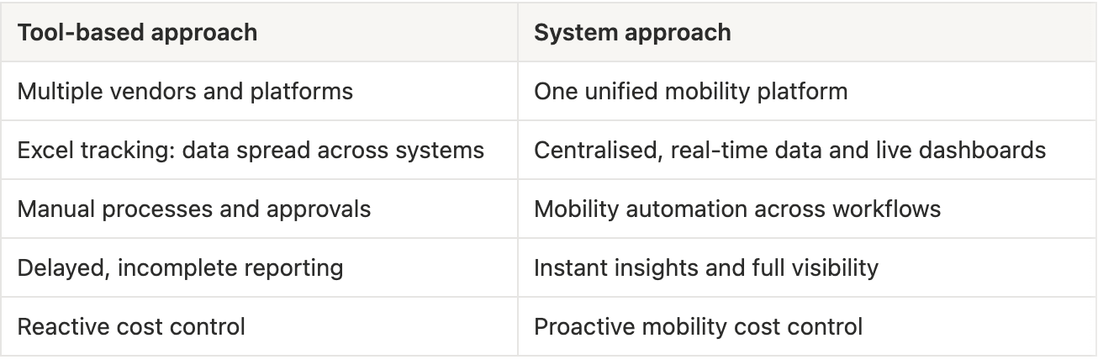
With a system, mobility management changes entirely. Instead of piecing together information, companies operate from a single source of truth. And instead of reacting after the fact, they gain the insight they need to act in real time.
Rethinking mobility management as a system #
Mobility management is moving from tools to systems, and that shift is changing how organisations operate. Once a set of separate tools and processes, mobility management is now becoming more connected. It's a system that supports cost control, operational efficiency, and better decision-making.
Continuing to rely on a fragmented mobility tech stack will only increase complexity. A unified mobility system, on the other hand, improves control. Because in the end, mobility is no longer something organisations manage, but something they optimise. And that starts by rethinking how mobility is managed in the first place.
Imagine what mobility would look like if everything worked as one system.


